|
||
32. Large Kamacite Spindles in an ungrouped Iron |
| Return to Contents |
| Back...Next |
| Meteorite - Cowra, ungrouped Iron. |
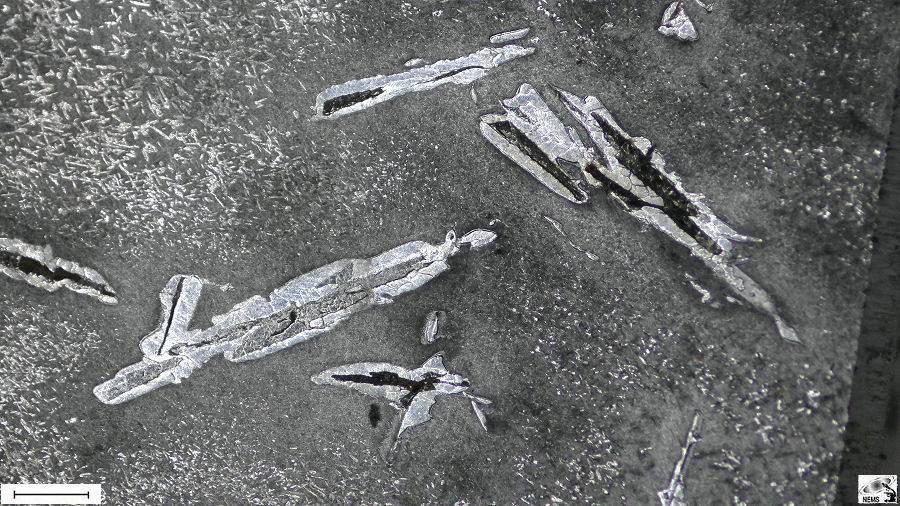
| Figure 1. Scale bar 400 µm. |
| Meteorite, Cowra, Ungrouped Iron. |
| Large kamacite spindles in the Cowra ungrouped iron meteorite. Scale bar=400 µm. |
| Large Kamacite Spindles in an
Ungrouped Iron Meteorite Figure 1. Large Kamacite Spindles in an Ungrouped Iron Meteorite Figure 2. Detailed view of kamacite spindles and associated structures. Figure 3. Additional micrograph showing spindle morphology and plessitic matrix. Scale bar=400 µm. Kamacite Spindles and Plessitic Octahedrites Kamacite spindles are elongated, lath- or spindle-shaped crystals of kamacite (α-FeNi; low-nickel body-centered cubic phase) that develop in certain iron meteorites through exsolution and growth during slow cooling. They are most characteristic of meteorites with bulk nickel contents in the range of approximately 4–7.5 wt% Ni, where kamacite nucleates and grows preferentially from taenite (γ-FeNi). In higher-nickel compositions (e.g., ~13 wt% Ni or greater), the stability field and diffusion kinetics suppress extensive Widmanstätten development, leading to reduced spindle sizes or alternative morphologies dominated by plessite. Plessitic octahedrites occupy a transitional structural category between classic octahedrites (with well-developed Widmanstätten kamacite lamellae) and ataxites (which lack macroscopic kamacite structures). These meteorites feature a matrix dominated by taenite and fine plessite intergrowths, within which kamacite occurs as isolated spindles or swathing rims around other phases. Accessory minerals such as schreibersite ((FeNi)3P) and troilite (FeS) are commonly present and can serve as nucleation sites. Elevated nickel contents (>12–13 wt% Ni) generally inhibit the formation of large-scale Widmanstätten patterns by shifting phase boundaries and reducing kamacite growth rates. Morphology and Formation in Cowra In plessitic octahedrites and related ungrouped irons, large kamacite spindles typically range from 2 to 32 mm in length and 0.5 to 1.5 mm in width. On polished and etched surfaces, they often appear tapered and aligned in up to three orientations corresponding to the octahedral planes of the parent taenite crystal, mimicking aspects of the Widmanstätten pattern at a smaller scale. These structures form via diffusional exsolution of kamacite from supersaturated taenite during protracted cooling in the parent body, typically over millions of years at temperatures below ~700–500 °C. The Cowra meteorite (bulk Ni ˜ 13.38 wt%) is a notable ungrouped iron that exemplifies these features. In Cowra, large kamacite spindles frequently occur as “swathing kamacite” — rims or sheaths enveloping primary platy schreibersite crystals — while the surrounding plessitic matrix contains abundant smaller spindles nucleated on preexisting kamacite grains or other heterogeneities. This texture reflects complex nucleation dynamics influenced by phosphorus and other minor elements. Vagn Buchwald originally described Cowra as a plessitic octahedrite in his 1975 Handbook, but subsequent chemical analyses (Ga, Ge, Ir, and other siderophiles) have placed it among the ungrouped irons, indicating it does not fit neatly into established magmatic or non-magmatic groups and likely derives from a distinct parent body. Broader Implications The study of kamacite spindle morphology, size distribution, and orientation in ungrouped irons like Cowra provides insights into local chemical heterogeneities, cooling rates, and the diversity of differentiation processes among early Solar System planetesimals. Such transitional textures highlight the continuum of Fe-Ni microstructures and underscore the value of combining detailed metallography with high-precision trace-element geochemistry for classification and thermal history reconstruction. |
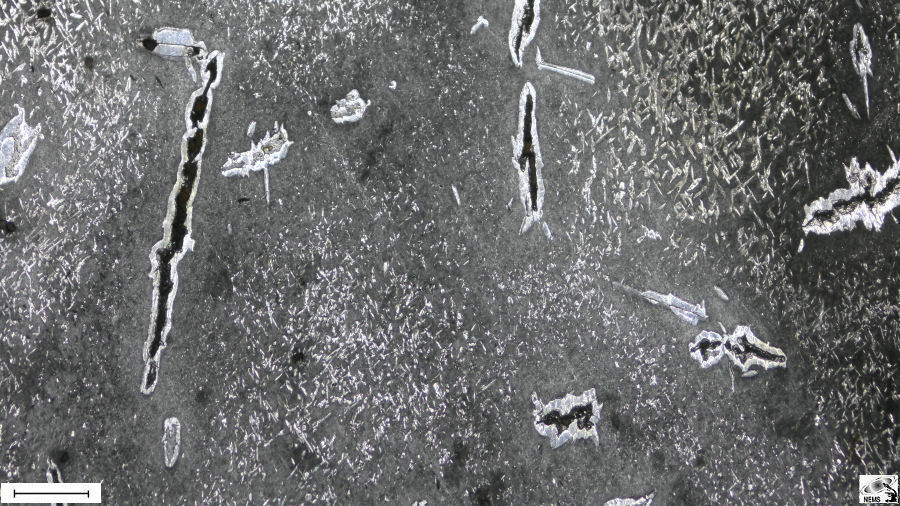
| Figure 2. Scale bar 400 µm. |
| Meteorite, Cowra, Ungrouped iron. |
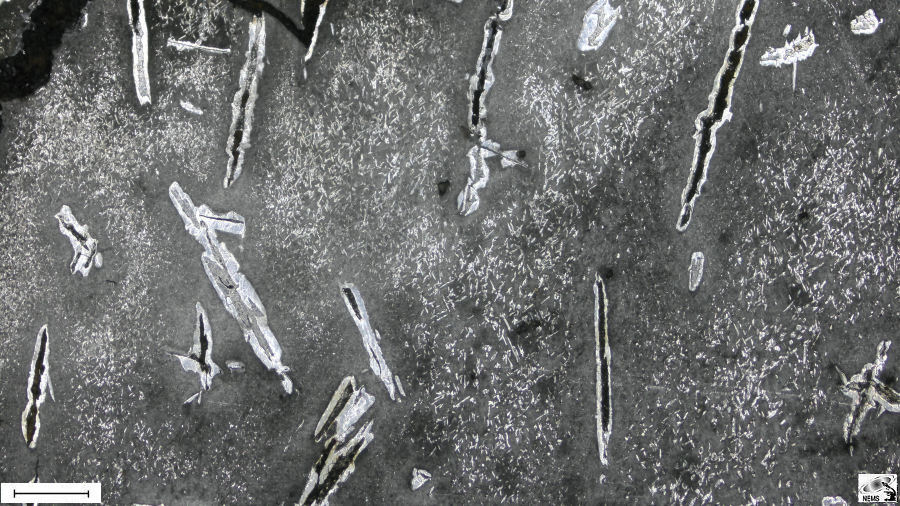
| Figure 3. Scale bar 400 µm. |
| Meteorite: Cowra, Ungrouped iron. |
| References • Buchwald, V. F. (1975). Handbook of Iron Meteorites: Their History, Distribution, Composition and Structure. University of California Press. (Primary description and classification of Cowra and related structures.) • Wasson, J. T., and others (chemical classification studies of ungrouped irons). • Supporting metallographic literature in Meteoritics & Planetary Science. |
| |
| Return to Contents |